

Axon Week 2026 – Music City Center, Nashville
Axon Week is public safety's premier training and technology conference. For 2026 in Nashville, Shepard stepped into an expanded role, collaborating closely with Axon's in-house talent across concept design, exhibit construction, and AV production. The result was a visually unified show that put Axon's most cutting-edge technology into the hands of its attendees. But most importantly, AW26 was an experience to remember. Learn more »
Over four days in April, public safety professionals from across the country and beyond filled the Music City Center in Nashville, Tennessee, for the most hotly anticipated Axon Week yet. They came to meet face-to-face and learn about the latest innovations in their lines of work, and Axon gave them a lot to see and try out.
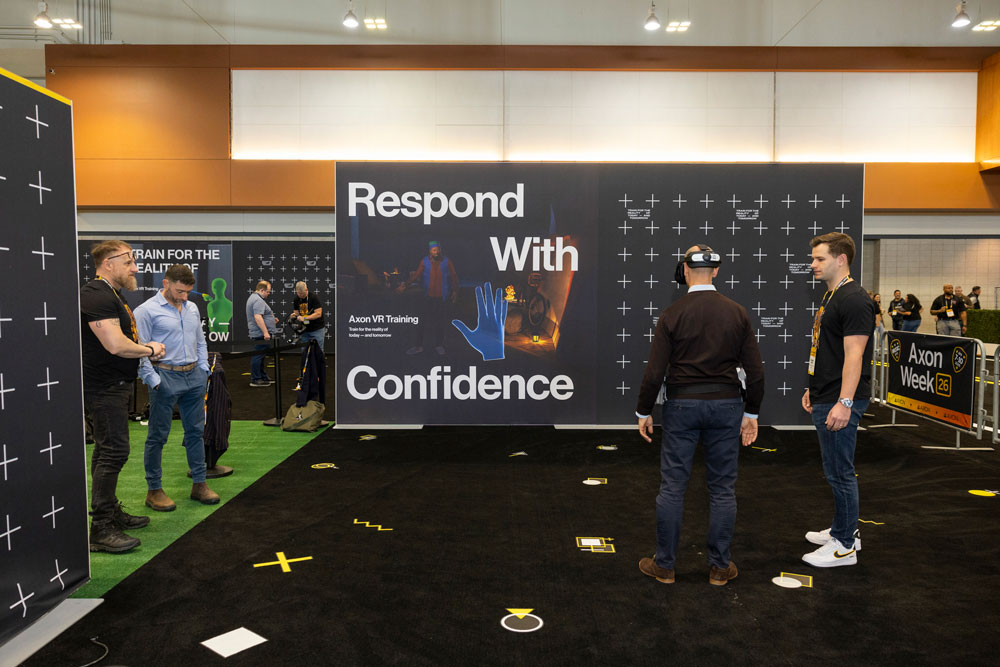
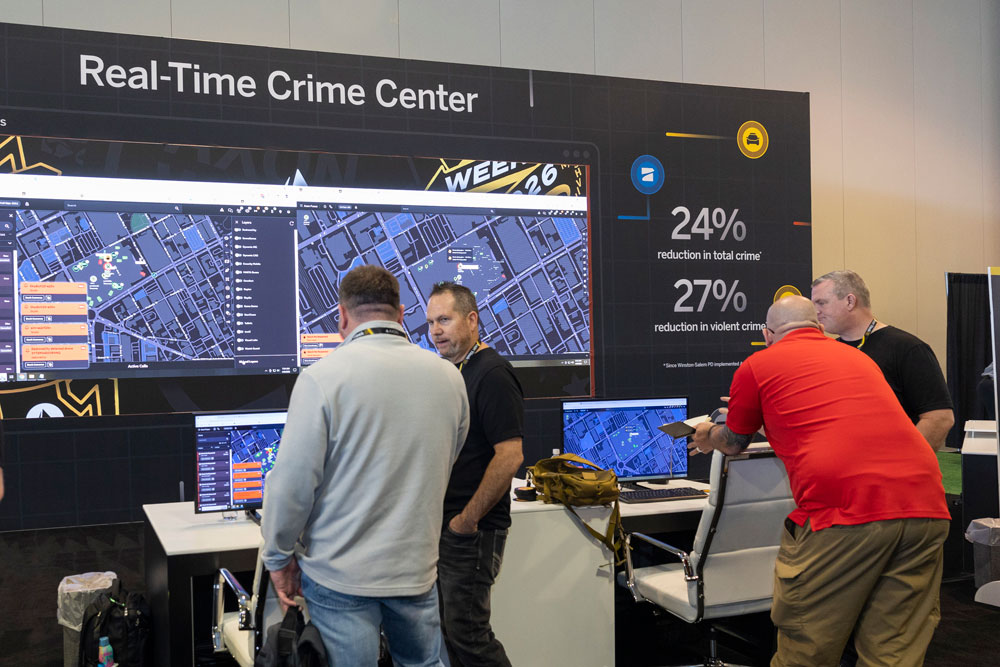
Attendees donned VR headsets and worked through training scenarios. They crowded around a working Real-Time Crime Center. And they got a first look at the new tools Axon unveiled this year: Axon Vision, which puts AI to work on live camera feeds; Axon Assistant, an AI helper expanding across Axon’s software; and Axon 911, a cloud system for emergency dispatch.
Demonstrations like these were the reason people came, and the floor had to be built to hold them, with sightlines to a stage, space for hands-on demos, and quiet corners for the conversations that follow.
Axon came into Nashville with growing momentum from the success of AW25 in Phoenix. Shepard had a smaller part in that event, building out structures and serving as General Service Contractor (GSC) on-site. This year the Shepard team joined the conversation earlier in the planning stages. Our ability to rapidly iterate on floor plan and exhibit design, coupled with deep venue knowledge, earned us an expanded role as GSC, AV provider, and trusted creative collaborator. The show that resulted felt like one piece rather than a collection of disparate exhibits — and it was Axon Week’s biggest yet.
Early collaboration and 3D renderings shaped the floor plan.
Axon set the strategy and owned the visual identity; our job was to make it real. That started with the relationship. Our National Sales Manager, Brad Hofer along with account managers Madison Pedigo-Fiorenini and Anthea Meier managed the account day to day, coordinating scope, schedule, and the many moving parts between Axon and our production teams, with Shepard’s Organizer App — the central nervous system of our event technology stack — giving everyone visibility into each stage.
With a strong foundation in place, the design ideation and iteration could move fast. Our concept designer, Chris Patch, helped turn Axon’s ideas into a collection of visually cohesive exhibits. Rather than send static PDFs, he would open a 3D model live on a conference call and walk Axon’s team, led by Melissa Guevara, through the space in real time. Decisions came quickly, and each round of revisions built on the last.
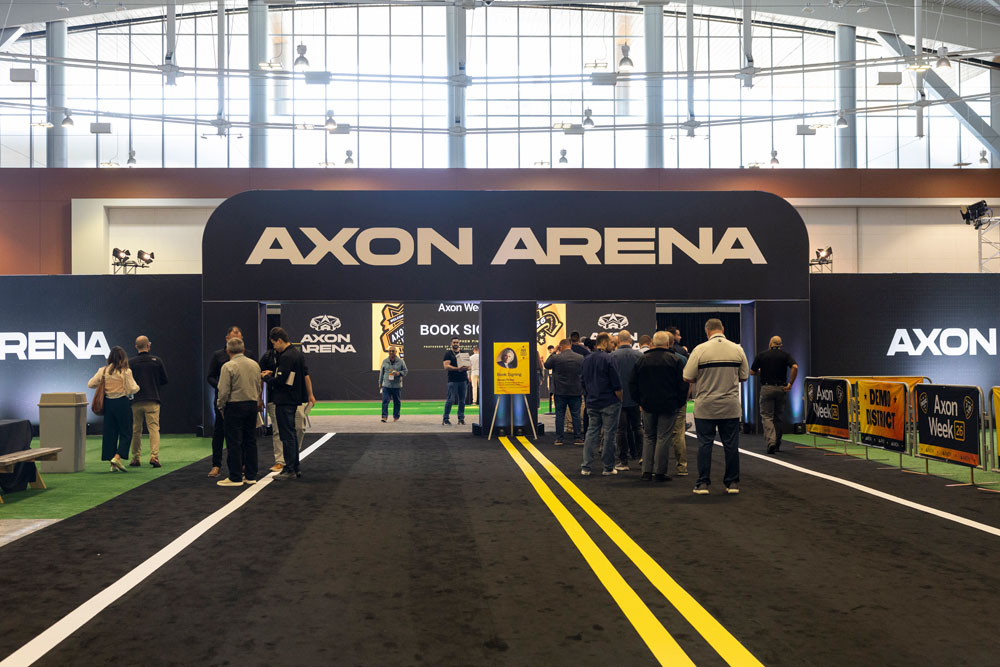
What emerged was a floor organized like a small city with an arena at its heart — a festive nod to this summer’s World Cup — and exhibit ‘districts’ branching off a 30 ft (~9 m) carpeted lane designed to look like a road.

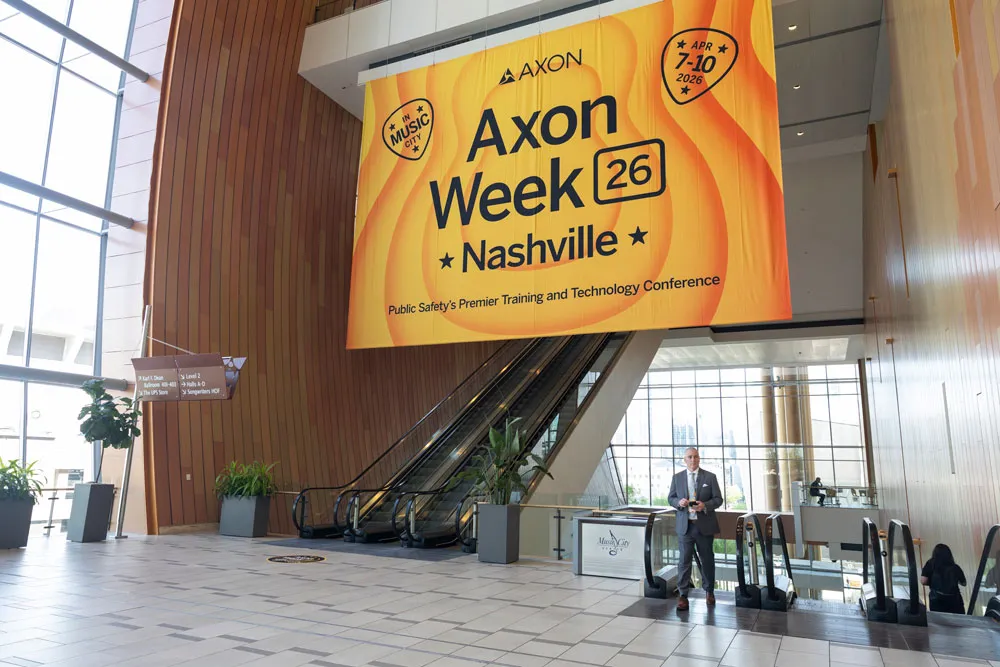
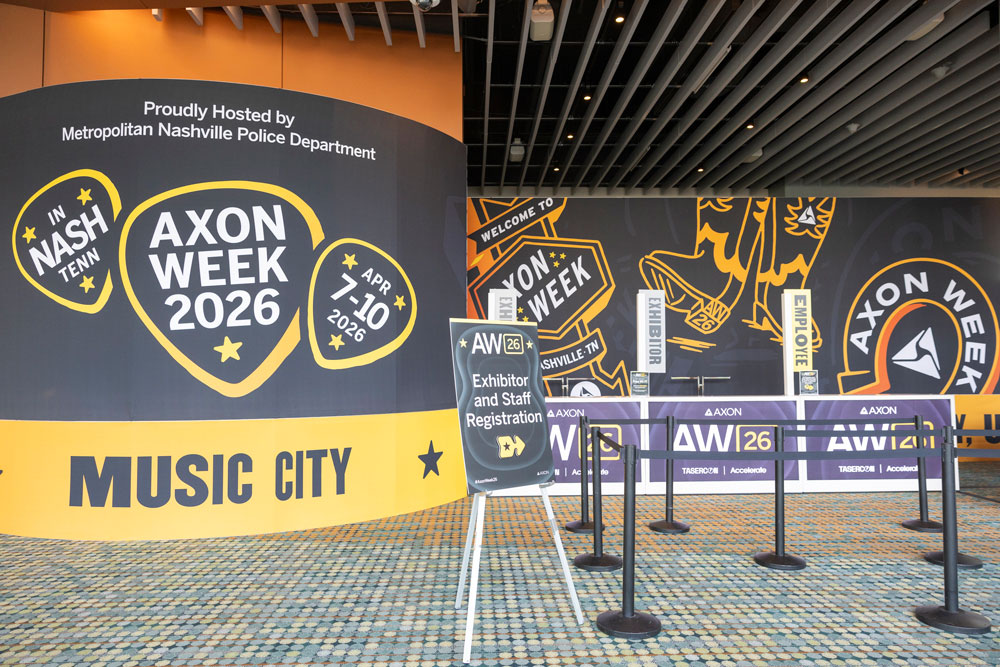
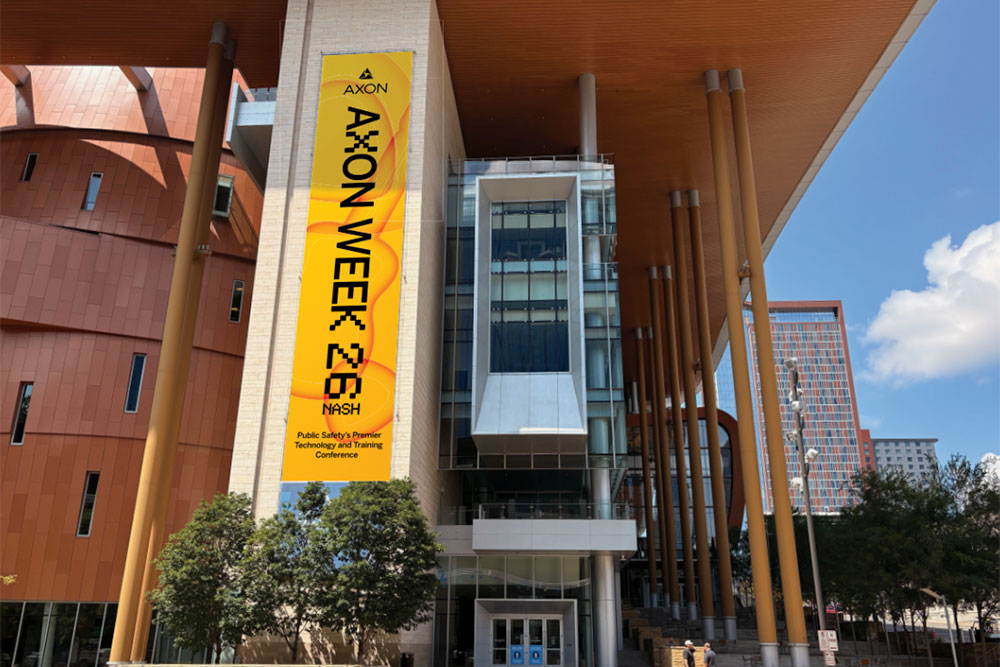
Axon's Nashville-centric visual identity system, translated into bespoke structures and graphics at Music City Center.
Axon’s in-house creative director, Blake Ingolia, developed a Nashville-inspired visual identity system in a futuristic, slightly glitchy register, with curvy guitar and pick shapes and a color palette embracing Axon’s signature gold and black. It felt modern and playful, and it held up at scale. The same visual language worked on a lanyard badge and on a huge LED wall. We handled the three-dimensional structures, panels, and floor decals, then supplied the exact sizes Ingolia’s graphics needed for printing, as well as the AV expertise to map the designs onto screens.
Much of the structure and graphics package came together in roughly 30 days. Revisions had to be locked in so our operations team could roll up their sleeves and get to work building, and so Ingolia’s team could design every graphic to fit our black-and-white structure drawings. It was a lot of work in a short window, and it held together because both teams stayed in close communication.
Inside the Axon Arena and Demo District
The exhibit areas were designed to be approached by a thirty-foot wide thoroughfare enabling clear sightlines. Ambitious entrance units announced the exhibit areas, each catering to a different subset of Axon Week’s attendee base.
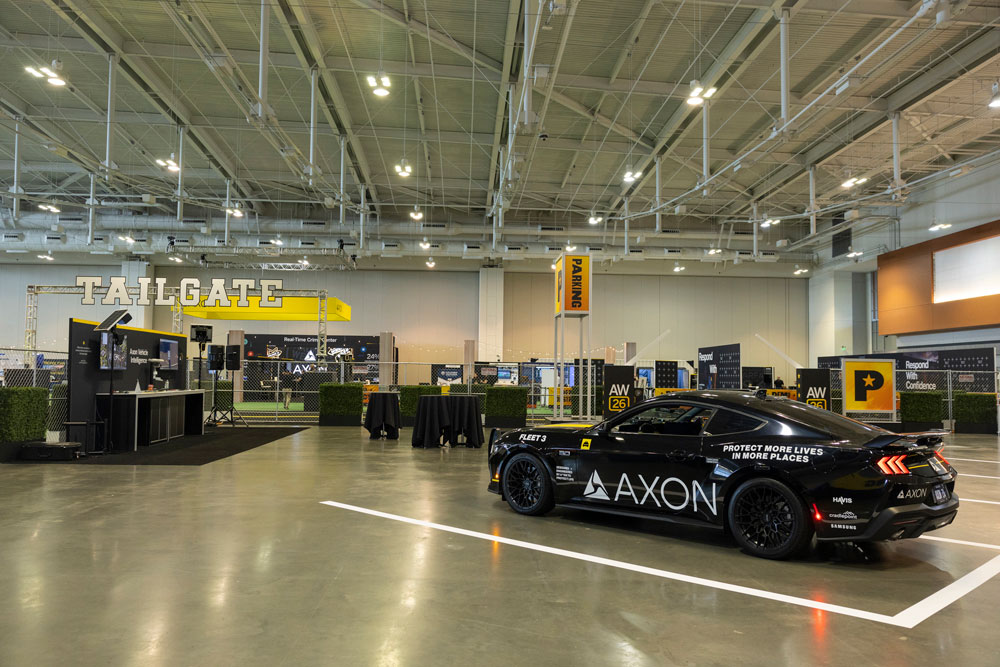
Edison-bulb lights strung between boxwood dividers at the “curbs” gestured toward the look and feel of a neighborhood, while astroturf and parking bays gave the effect of a sporting arena and its environs.
Axon Arena: At the far end, drawing everyone forward, was the Axon Arena: an astroturf-clad “football pitch” bounded on one side by a branded arch with an embedded LED screen, and stadium-style bleachers assembled around it.
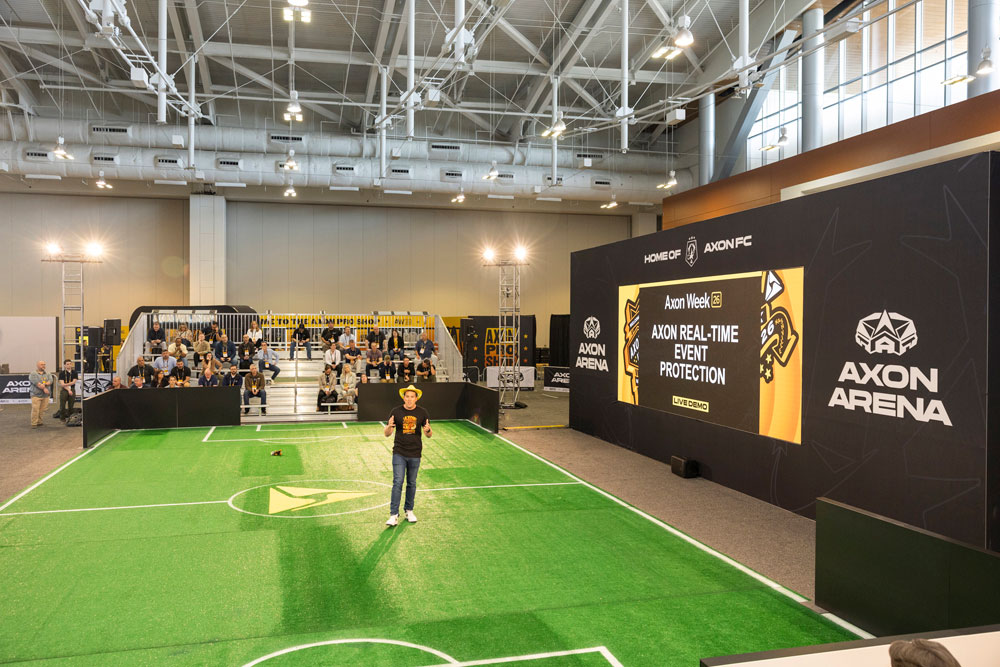
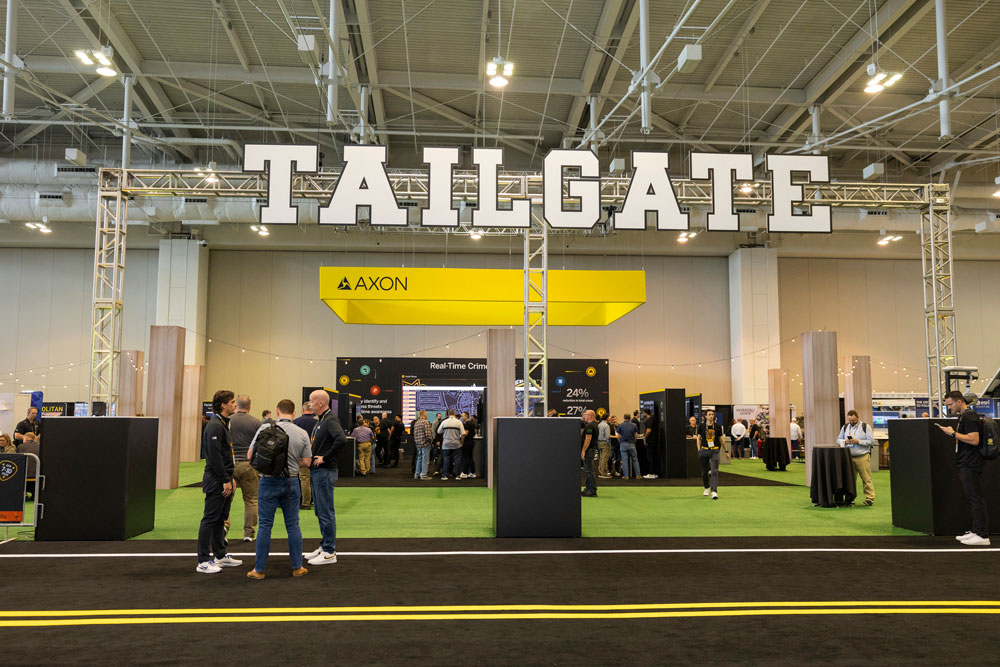
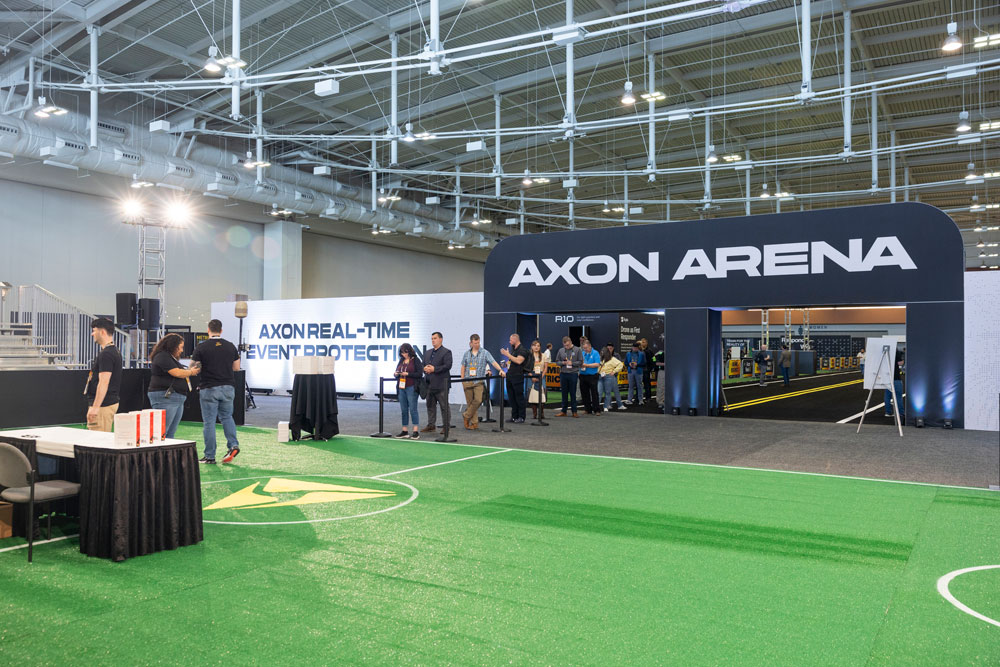
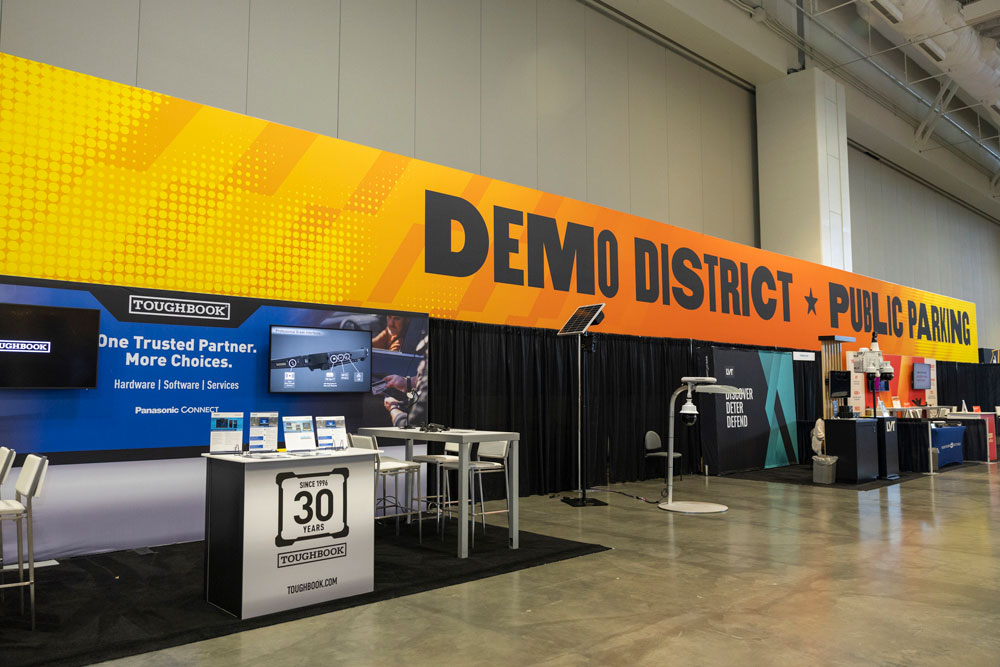
Demo District: The Demo District, framed as a public parking lot, put Axon’s Fleet vehicles and partner exhibitors in painted bays alongside the Drone as First Responder flight station. The Real-Time Crime Center recreated the command-center atmosphere Axon cultivates in its brand presentation. Across the way, VR Training invited visitors to “Respond With Confidence.”
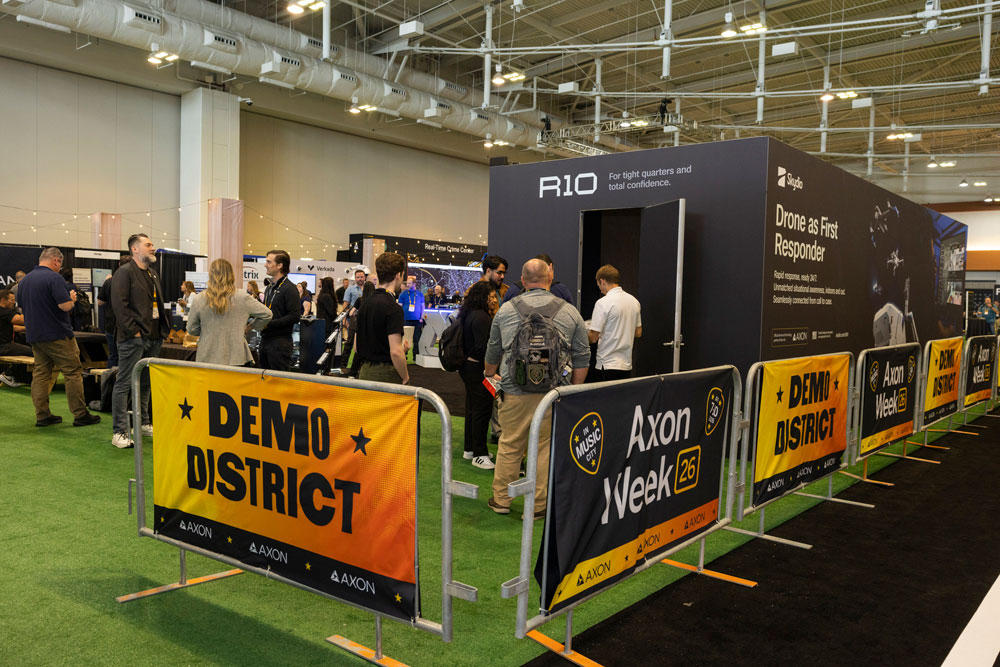
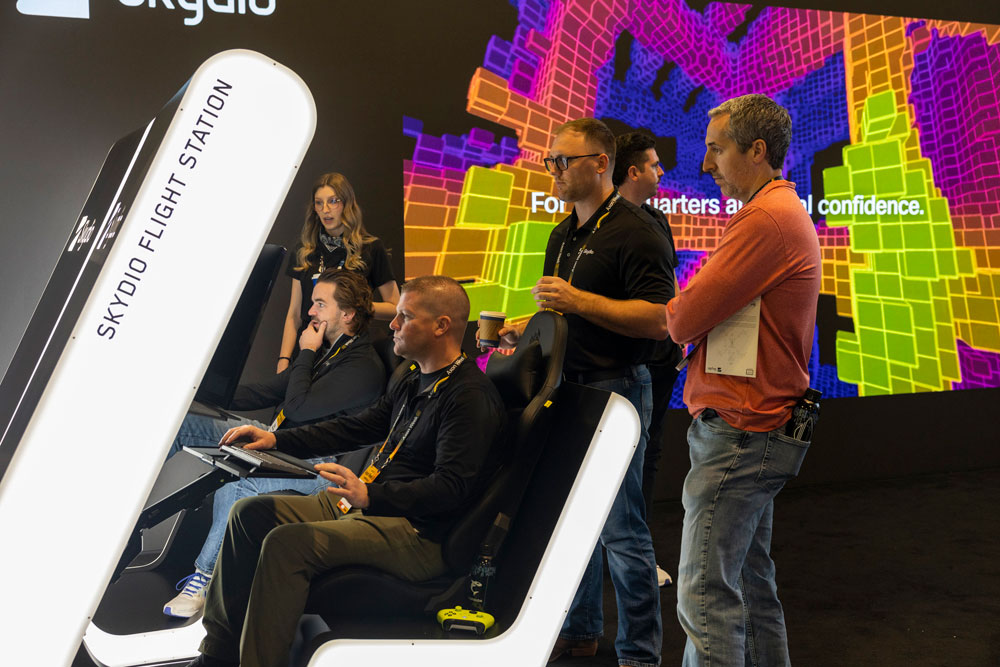
Beyond lighting and audio: integrated AV elevated the experience.
The Arena hosted the week’s most ambitious piece of staging. To show off Axon’s Real-Time Event Protection, the team staged an interruption: an unruly fan breaks into the presentation and takes off across the field. The presenter demonstrated, in real-time, how a security team could follow that person through a crowd as events unfolded. The concept required strong AV support from Shepard AV.
Our AV team, led by Cory Souza with boots-on-the-ground support from Luc Cloutier, tracked the action wirelessly with multiple cameras as it moved out of the Arena and into the exhibit hall, holding the image live on the main screen. We also handed Axon remote command of that screen from an iPad, so they could switch between camera views throughout the show.
The full integrated AV package included two roughly 8-by-21-foot LED walls and a third 117-by-58-inch wall, plus monitors, audio, lighting, and laptops throughout the floor.
Shepard's Music City Center know-how – labor, logistics, venue protocols – saved Axon time and money.
Producing at this scale in Nashville drew on our familiarity with Music City Center, a venue our teams know well from events we’ve delivered there. That kind of local knowledge shows up in conversations around labor requirements, logistics, and floor plan possibilities, and in the coordination that carries a show from setup through teardown. An ambitious floor plan becomes an seamless experience for attendees and exhibitors when the team building it already knows the venue inside out.
Our track record producing major conventions and summits at Music City Center:
- TechAdvantage Expo (NRECA’s utility industry show) – see case study
- Nationwide PrimeTime
- THB-HTS Spring Summit
- NAPA 401(k) Summit
Looking ahead to 2027
Driving Results on the Show Floor
Client
Axon
Industry
Public safety software and technology
Service Type
Venue
The Music City Center
Location
Nashville, TN
Year
2026


